What Are Acoustic Absorbing Panels and How Do They Work?
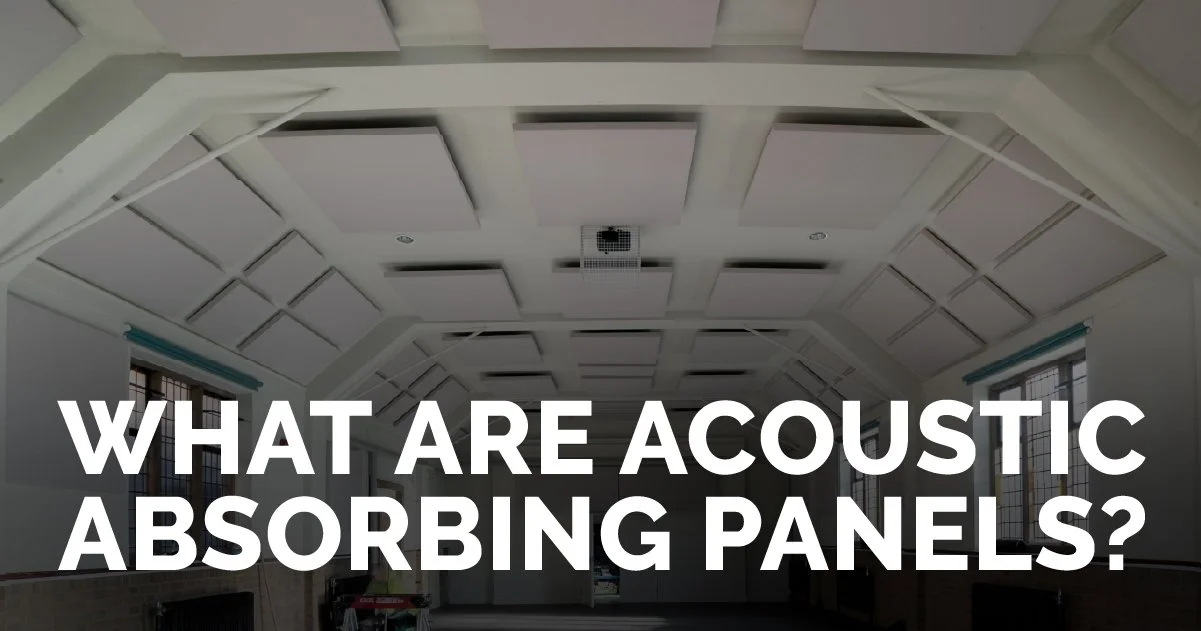
Walk into a school hall, a busy café or an open-plan office and you’ll often hear the problem before you see it. Voices blur together, noise builds, and conversations take effort. Usually the room isn’t too loud because of the people in it. It’s loud because sound has nowhere to go.
Acoustic absorbing panels are one of the simplest and most effective ways to fix that. Here’s what they are, how they work, and where they make the biggest difference.
What are acoustic absorbing panels?
When sound hits a surface, it does one of three things: it reflects back into the room, it’s absorbed, or it’s diffused (scattered in different directions). Hard, flat surfaces like plaster, glass, concrete and wooden floors reflect almost everything.
Absorbing panels are designed to do the opposite. They have a porous core, usually mineral wool, recycled PET or another sound-absorbing material, wrapped in acoustic fabric or another finish that lets sound pass through. Instead of bouncing back, the sound travels into the panel and is turned into a tiny amount of heat.
They can be fixed to walls, hung from ceilings as rafts or baffles, or built into stretch-fabric systems. They come in almost any size, shape and colour.
How do absorbing panels work?
They stop sound bouncing around the room
Every reflection off a hard surface keeps sound alive in the room for longer. Each panel takes some of that energy out, so fewer reflections reach your ears.
They shorten reverberation time
Reverberation time is how long it takes for a sound to die away after it stops. It’s the main measure acousticians use. In a hard, untreated hall it can stretch to several seconds, so each word overlaps the one before. Adding enough absorption brings it down to a level where speech is clear and the room feels calm.
They reduce the noise build-up
In a busy room, people raise their voices to be heard over the echo, which makes the room louder still. This is sometimes called the Lombard effect. Absorption breaks that cycle, so the whole space settles down.
What’s the difference between absorption and soundproofing?
This is the most common mix-up in acoustics. Absorbing panels improve the sound inside a room: less echo and clearer speech. They don’t stop sound travelling through walls to the room next door. That’s soundproofing, which needs mass, airtightness and separation built into the structure.
If your problem is “it’s echoey and hard to hear in here”, you need absorption. If it’s “we can hear next door”, you need soundproofing. We explain this in more detail in Soundproofing vs Sound Absorption: The Common Mistake Everyone Makes
What does “Class A” mean?
Panels are rated by how much sound they absorb, using a scale from Class A down to Class E (BS EN ISO 11654). A Class A panel absorbs at least 90% of the sound that hits it across the main speech frequencies. A Class E panel absorbs only a small fraction.
The rating depends on the material, its thickness and how it’s mounted. A panel fixed with an air gap behind it often performs better than the same panel fixed flat to the wall. When comparing products, always ask for the tested rating, not just a description. Most of the panels we manufacture achieve Class A.

Where do absorbing panels make the biggest difference?
Schools and classrooms
Children are still learning to pick out speech from background noise, so poor acoustics hit them hardest. School buildings have their own acoustic standards (BB93), and treating classrooms and halls is one of our most common projects. Examples include our work at Polden Bower School in Bridgwater and Redmaids’ High School in Bristol.
Village halls and community spaces
High ceilings and hard floors make halls versatile, but echoey. Treatment makes them usable for talks, classes and events, and more welcoming for people with hearing loss.
Offices and meeting rooms
Open-plan offices and glass-walled meeting rooms suffer from noise build-up and poor call quality. Panels improve concentration and make video calls far clearer.
Hospitality and venues
Restaurants, bars and cafés lose customers when conversation becomes hard work. At the O2 Academy Bristol, we manufactured and installed over 80 bespoke panels to control the sound in the venue.
Healthcare and care homes
Calmer, quieter spaces support wellbeing for residents, patients and staff, as at Kelly Farm Care Home in Tiverton.
[H2] How many panels do you need?
It depends on the room’s size, its surfaces and what it’s used for. Treating a meeting room is very different from treating a sports hall. As a rough guide, larger and harder rooms need more coverage, and ceilings are often the most effective place to start. Our guide How Many Acoustic Panels Do I Need? goes into more detail, but the most reliable answer comes from a site assessment.
Bespoke panels, made in Somerset
At ISS Acoustic & Interiors, we design and manufacture absorbing panels in our own workshop in Wells, Somerset, and install them across the UK. Every project starts with understanding the space, so we can specify the right amount of absorption in the right places, in a finish that suits the room.
References and Further Reading
See our fabric-wrapped acoustic wall panels, read Absorption or Diffusion? What’s Right for Me?, or book a free consultation.
Our sensory experiences span a broad spectrum. Certain noises, lights, tastes, smells, temperatures, textures or activities can be enjoyable and comforting to one person, yet unpleasant or distressing to another. What feels insignificant to some can have a considerable impact on someone else's ability to feel comfortable, concentrate or participate in everyday activities.

Could your space benefit from better acoustics?
At ISS Acoustic & Interiors, we specialise in transforming spaces into calm, focused, and productive environments.
Custom acoustic solutions to meet BB93 standards
Whether you're responsible for a school, workplace, community building or refurbishment project, ISS Acoustic & Interiors can help you explore ways to improve acoustic comfort and speech clarity.